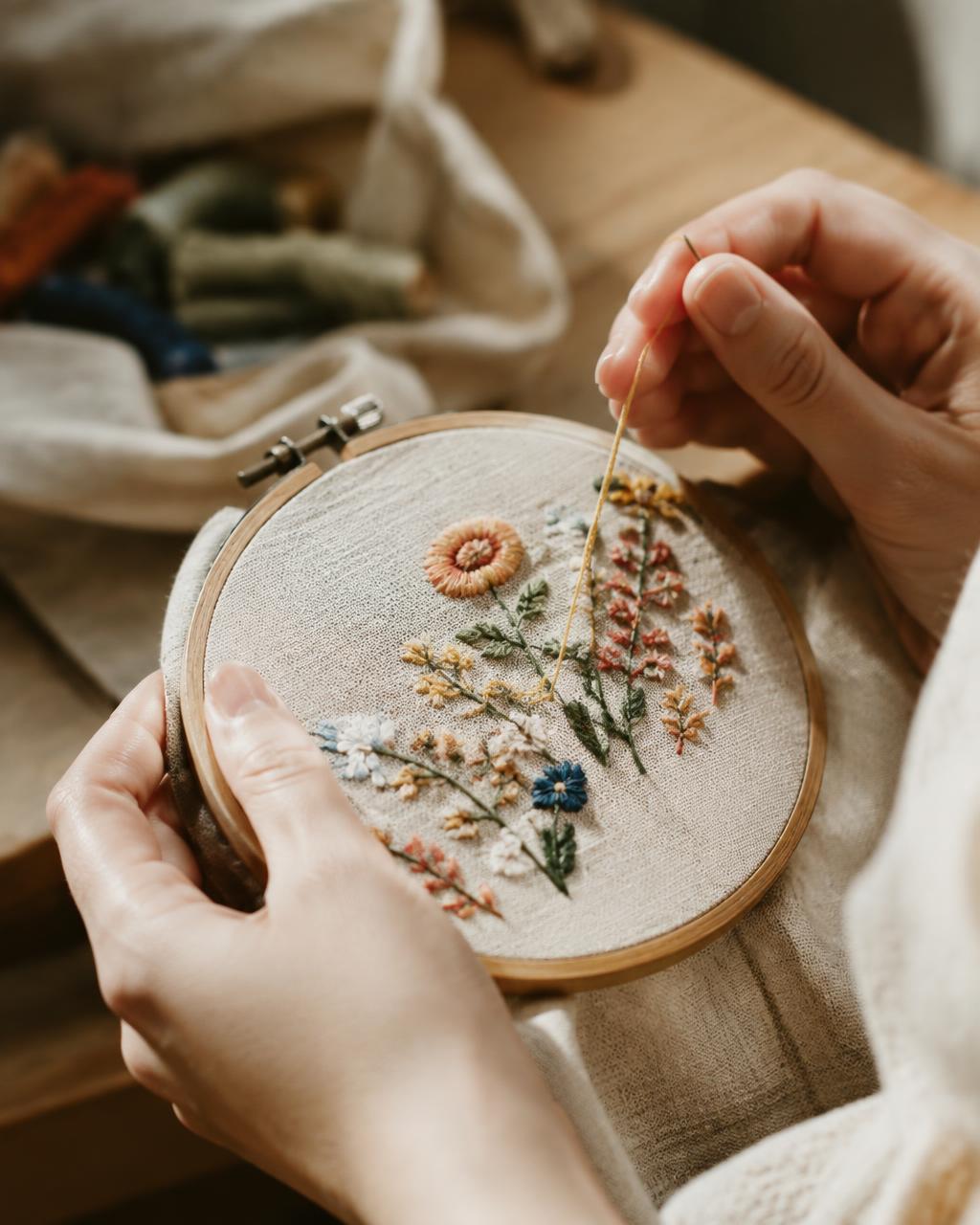
Embroidery has a reputation for being fussy, old-fashioned or only for the extremely patient. In practice it's one of the most forgiving crafts you can pick up: you need very little, mistakes can be unpicked in seconds, and a single evening is enough to finish something you'll want to keep.
This guide covers everything you need for your first hoop — the kit, the five stitches that do most of the work, and a simple first project.
Why embroidery is a great first craft
It's quiet, it's portable and it rewards attention without demanding perfection. Unlike knitting, there's no counting; unlike painting, every stitch can be undone.
Low cost — a full starter kit costs about the same as a takeaway.
Small footprint — everything fits in a pencil case.
Quick wins — a simple motif takes one or two evenings.
What you need to start
Item | What to look for | Rough cost |
|---|---|---|
Hoop | Wooden, 15–20cm, with a screw | £3 |
Fabric | Linen or cotton, tightly woven | £5 |
Thread | Stranded cotton, 6–8 colours | £8 |
Needles | Embroidery needles, sizes 5–9 | £2 |
Five stitches to learn first
You can stitch almost any design with these five. Practise each on a scrap square before starting a real piece.
1. Back stitch
The workhorse for outlines and lettering. Small, even stitches that each step back into the end of the last.
2. Satin stitch
Long parallel stitches that fill a shape with smooth, glossy colour.
3. French knot
A tiny raised dot — perfect for flower centres, eyes and texture.
Bring the needle up through the fabric.
Wrap the thread twice around the needle.
Insert the needle back down right beside where it came up, holding the wraps taut.
Your first project
Choose a small botanical motif — a single stem with three leaves and a flower. It uses back stitch, satin stitch and one French knot, and it looks lovely even when it's imperfect.
Before you begin — checklist
Fabric is drum-tight in the hoop
Design traced lightly with a water-soluble pen
Thread cut to forearm length
Two of six strands separated
Common beginner mistakes
Using too much thread at once, pulling stitches too tight and starting with a design that's too big. All three are easy to fix — and all three are part of learning.
"The back of your work doesn't need to be neat. Nobody is going to turn it over."
Once you've finished your first hoop, you'll have every skill you need for the next one. Pick something slightly harder, and keep going.