15 Easy Watercolor Painting Ideas for Beginners (That Actually Look Good)
You don't need to know how to draw a perfect landscape, understand color theory, or own an expensive set of paints to make something beautiful with watercolor.
Sometimes, all you need is a brush, a little water, and an idea simple enough to finish in one sitting.
The tricky part is knowing what to paint first. A blank sheet of watercolor paper can feel surprisingly intimidating, especially when you're new to painting.
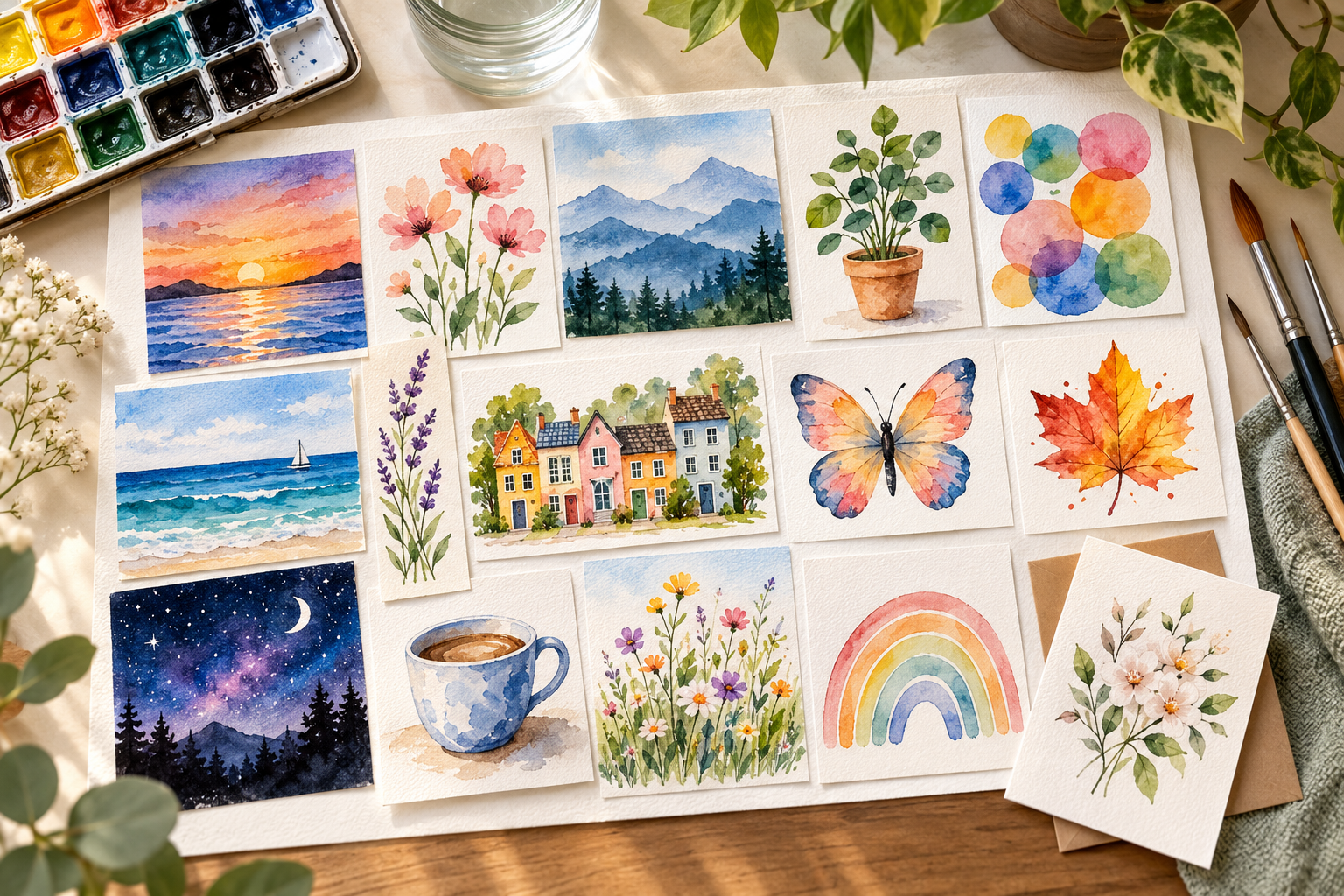
That's why we've put together 15 easy watercolor painting ideas for beginners. These projects use simple shapes, forgiving techniques, and everyday subjects. Most can be finished in 10–30 minutes, and none requires advanced drawing skills.
The goal isn't to create a masterpiece. It's to make something you enjoy looking at—and perhaps discover a creative hobby you want to return to.
Before You Start: Keep Your Setup Simple
You don't need a professional art studio for any of these projects.
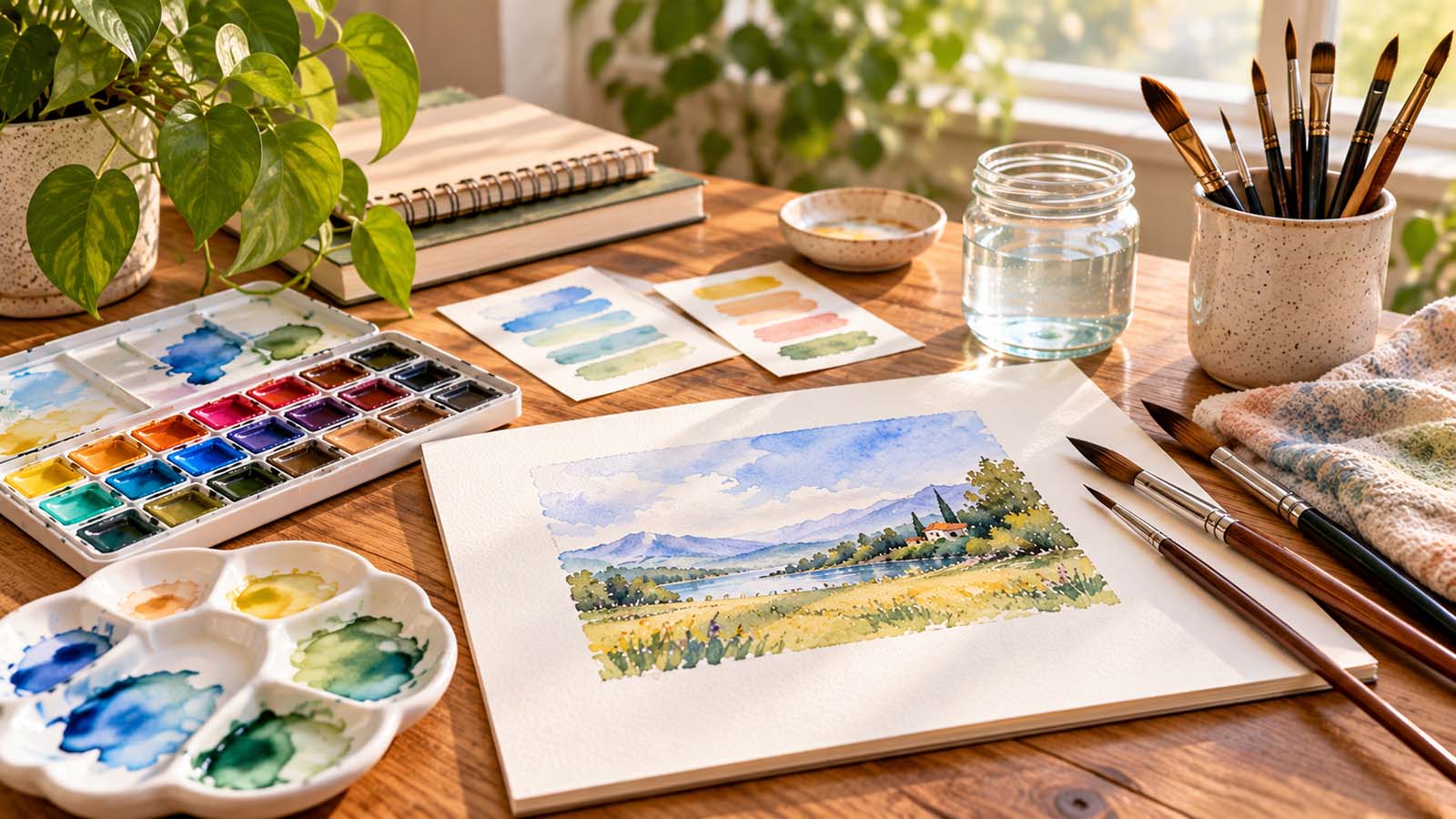
A basic setup includes:
A small watercolor paint set
Watercolor paper, ideally around 300 gsm (140 lb)
One medium round brush and one smaller brush
A jar of clean water
A cloth or paper towel
A pencil and eraser, if you'd like to sketch first
A limited palette is perfectly fine. In fact, using fewer colors can make your paintings feel more cohesive.
If you're completely new to watercolor, start with our guide to watercolor painting for beginners. It explains the basic supplies, brush techniques, and how to control water and pigment.
A beginner-friendly rule: Start small. A postcard-sized painting is easier to finish, uses less paint, and feels less overwhelming than a full sheet.
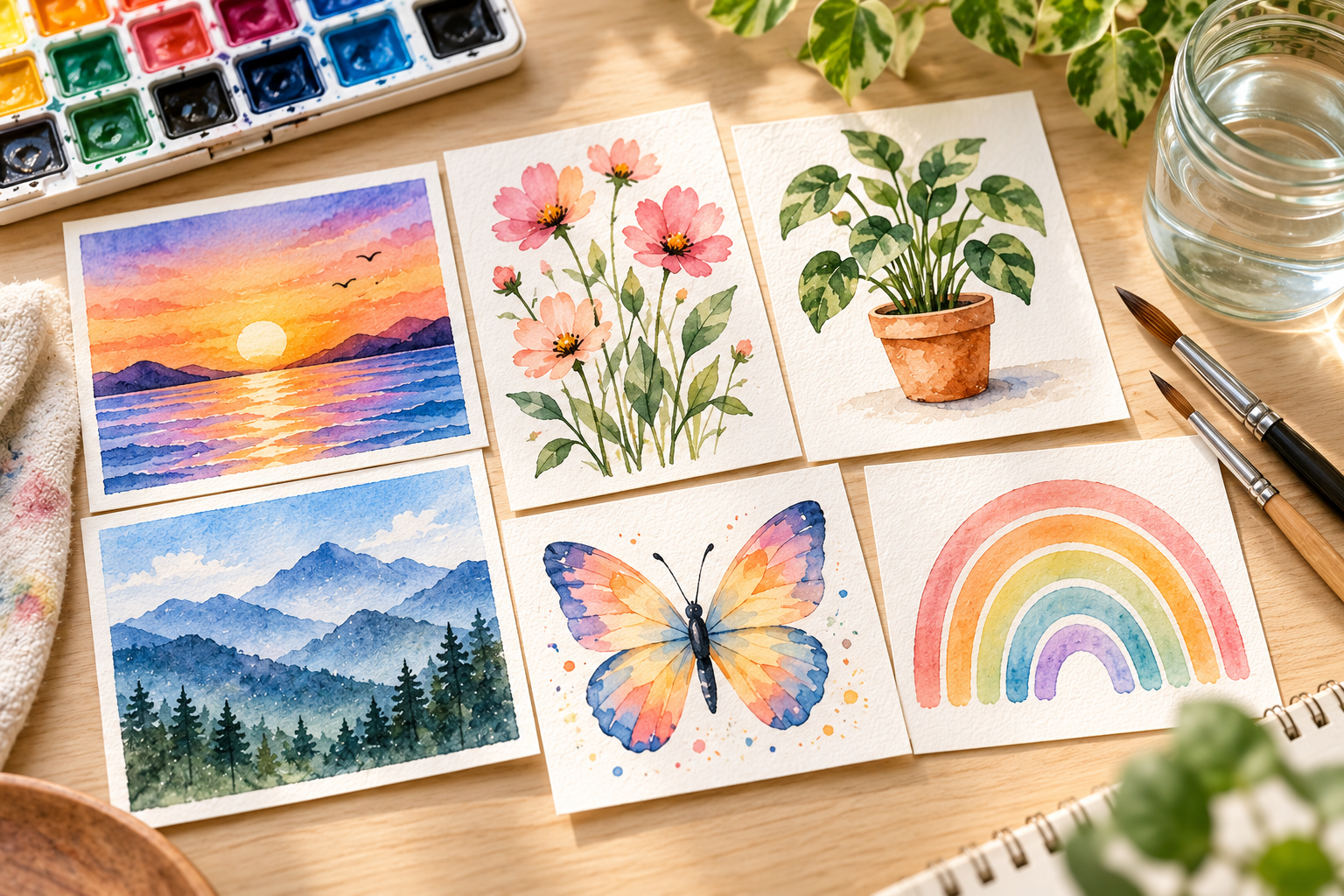
1. A Simple Sunset Sky
Difficulty: Very easy
Time: 10–15 minutes
You'll practice: Blending colors
A sunset is one of the easiest watercolor subjects because soft, imperfect color transitions are part of its beauty.
How to paint it
Lightly wet the upper portion of your watercolor paper with clean water.
Brush a soft yellow band near the horizon.
Add orange above it, followed by pink or purple.
Let the colors blend naturally without overworking them.
Once the sky is dry, paint a simple dark horizon or distant hills.
You don't need to paint the sun, but you can leave a small unpainted circle if you'd like a brighter focal point.
Try this: Make three tiny sunset paintings using different color combinations. You'll discover how much the mood changes with just a few colors.
2. Loose Watercolor Flowers
Difficulty: Easy
Time: 15–20 minutes
You'll practice: Brush control and loose shapes
Flowers are a wonderful beginner subject because they don't need perfect symmetry to look convincing.
How to paint them
Load your brush with a diluted pink, purple, or yellow.
Make five loose petal-shaped marks around a small center.
Leave tiny white gaps between some petals.
Add a darker dot or circle in the middle.
Paint thin green stems and a few simple leaves.
Try painting three flowers at different heights instead of one large bloom.
Beginner tip: Don't outline every petal. Let the soft watercolor edges suggest the flower's shape.
3. A Minimal Mountain Landscape
Difficulty: Easy
Time: 15–25 minutes
You'll practice: Layering and depth
You can create a beautiful mountain scene using nothing more than overlapping silhouettes.
How to paint it
Mix a very pale blue or lavender.
Paint a distant mountain range using simple triangular and uneven shapes.
Allow it to dry completely.
Paint a slightly darker mountain range in front.
Add one final darker layer near the bottom.
The lightest mountains should appear farthest away, while darker shapes feel closer.
Keep the sky white or add a very light wash.
Why it works: Overlapping layers create a sense of distance without requiring complicated details.
4. A Tiny Potted Plant
Difficulty: Easy
Time: 15–20 minutes
You'll practice: Simple shapes and leaf marks
A small houseplant makes a charming watercolor illustration—and you can use a real plant as your reference.
How to paint it
Lightly sketch a simple flowerpot or rounded container.
Paint the pot in terracotta, beige, or another muted color.
Add a few thin stems extending upward.
Press your brush gently to create oval-shaped leaves.
Add darker green touches after the first layer dries.
Don't worry about making every leaf identical. Slight variations make the plant look more natural.
For a playful variation, paint three different potted plants side by side.
5. Colorful Abstract Circles
Difficulty: Very easy
Time: 10 minutes
You'll practice: Color mixing and water control
If drawing makes you nervous, start with abstract art.
How to paint it
Choose three to five colors that work well together.
Paint loose circles in different sizes across your paper.
Vary the amount of water to create lighter and darker circles.
Leave small gaps between most shapes.
Let everything dry before adding optional tiny details.
You can arrange the circles in neat rows or scatter them freely.
Try this: Paint a page using only blue and green. Then make another using warm colors like orange, pink, and yellow.
The results can look surprisingly polished, even when the technique is simple.
6. A Peaceful Ocean Horizon
Difficulty: Easy
Time: 15–20 minutes
You'll practice: Horizontal washes
An ocean scene doesn't need crashing waves or detailed reflections.
How to paint it
Lightly mark a horizon line across the paper.
Paint a pale blue sky above it.
Allow the sky to dry enough that the colors won't run together.
Paint the ocean below using horizontal blue and turquoise strokes.
Add a few darker, thin horizontal marks to suggest distant waves.
Leave small white gaps in the water to create a feeling of light.
For an extra detail, add a tiny distant sailboat using a fine brush.
7. A Simple Watercolor Bookmark
Difficulty: Very easy
Time: 15–20 minutes, plus drying
You'll practice: Composition on a small surface
This project gives you something practical to use after painting.
How to paint it
Cut a strip of watercolor paper approximately 5 × 15 cm.
Choose a simple theme: flowers, leaves, stars, or abstract color washes.
Paint your design, leaving a little breathing room around the edges.
Let it dry completely.
Trim the edges neatly if necessary.
You can add a hole and ribbon if you like, but a simple painted strip works just as well.
Make several bookmarks in different color palettes for an easy handmade gift.
8. A Row of Little Houses
Difficulty: Easy
Time: 20–30 minutes
You'll practice: Basic shapes and composition
Tiny houses can be wonderfully charming even when their lines are slightly crooked.
How to paint them
Lightly sketch three to five rectangles with triangular or sloping roofs.
Paint each house in a different soft color.
Leave the roofs or windows unpainted where possible.
Once dry, add doors and windows with a smaller brush.
Paint a few tiny trees or shrubs around the houses.
Keep the buildings intentionally simple.
Creative variation: Use a limited palette of terracotta, mustard yellow, sage green, and pale blue for a cohesive little village.
9. A Loose Watercolor Butterfly
Difficulty: Easy
Time: 15–25 minutes
You'll practice: Symmetry and soft blending
Butterflies are a good subject for exploring how watercolor spreads across wet paper.
How to paint it
Lightly sketch a narrow body and two pairs of wings.
Wet one wing area with clean water.
Drop in two colors and allow them to mingle.
Repeat on the opposite side, aiming for a similar—not identical—shape.
Let the wings dry before painting the body and antennae.
You can add a few dots or markings once the first layers are completely dry.
Don't aim for perfect symmetry. A handmade quality is part of the charm.
10. A Single Autumn Leaf
Difficulty: Easy
Time: 15–20 minutes
You'll practice: Wet-on-wet blending
An autumn leaf is ideal for experimenting with red, orange, yellow, and brown.
How to paint it
Sketch a simple leaf shape with a short stem.
Wet the inside of the shape with clean water.
Add yellow first, then touches of orange and red.
Let the pigments blend gently.
Once dry, add a thin stem and a few veins.
Use a real leaf as inspiration if you have one nearby.
Beginner tip: Avoid repeatedly brushing over the wet colors. A few well-placed touches often look better than constant adjustments.
11. A Night Sky with Stars
Difficulty: Easy
Time: 20–30 minutes
You'll practice: Dark washes and contrast
A night sky is a satisfying way to practice deeper watercolor colors.
How to paint it
Wet the sky area lightly.
Apply dark blue, indigo, or purple in broad washes.
Allow some areas to remain lighter for variation.
Let the painting dry completely.
Add small stars with white gouache or an opaque white paint pen.
For a simpler version, leave tiny unpainted white spots before applying the darker wash.
You can also add a dark mountain or tree silhouette along the bottom.
Note: Ordinary transparent white watercolor may not show clearly over a dark background, so an opaque medium works better for bright stars.
12. A Cup of Tea or Coffee
Difficulty: Easy
Time: 20–30 minutes
You'll practice: Everyday-object illustration
A familiar mug is a lovely subject for a relaxed painting session.
How to paint it
Sketch a simple mug shape with a handle.
Paint the body in one soft color.
Add a slightly darker wash along one side to suggest a shadow.
Paint the tea or coffee surface using a warm brown.
Once dry, add a few simple details or a shadow beneath the mug.
Don't worry about realistic perspective. A flat, illustrative style can be just as appealing.
This is a great project to try while enjoying your actual morning tea or coffee.
13. A Field of Simple Wildflowers
Difficulty: Easy
Time: 20–25 minutes
You'll practice: Repetition and loose brushwork
A wildflower field looks more complex than it really is.
How to paint it
Paint a pale green wash near the bottom of the paper.
Add several thin stems at different heights.
Use tiny dots, short strokes, or simple petals for flower heads.
Vary the colors and sizes slightly.
Add a few darker green strokes to suggest grass.
Keep the upper portion of the page mostly empty, or add a light sky.
The trick is to suggest a field of flowers rather than paint every individual plant.
14. A Soft Rainbow
Difficulty: Very easy
Time: 10–15 minutes
You'll practice: Curved brushstrokes and color spacing
A watercolor rainbow is a quick project for days when you have very little time.
How to paint it
Choose four to six colors.
Paint one broad curved stroke.
Leave a small gap and paint another curved stroke beneath it.
Continue until your rainbow is complete.
Let it dry naturally.
Use muted colors for a gentle, modern look, or brighter shades for something playful.
You can also paint several miniature rainbows on one sheet.
Try this: Make a rainbow using unexpected colors, such as sage, dusty pink, ochre, and lavender.
15. A Personalized Watercolor Greeting Card
Difficulty: Easy
Time: 20–30 minutes, plus drying
You'll practice: Combining simple techniques
Once you've tried a few of the previous projects, combine your favorite elements into a small greeting card.
How to paint it
Fold a piece of suitable watercolor paper into a card, or paint a separate panel to attach to a blank card.
Choose one simple design, such as flowers, a sunset, or a little house.
Paint the design in the center or along one edge.
Allow it to dry completely.
Add a short handwritten message if you wish.
You don't need complicated lettering or elaborate decoration.
A small handmade card can feel more personal than something bought in a shop.
Which Watercolor Painting Idea Should You Try First?
If you're having trouble choosing, use this quick guide.
If you want to… | Try this project |
|---|---|
Finish something in 10 minutes | Abstract circles or a soft rainbow |
Practice blending colors | Sunset sky or autumn leaf |
Paint something from nature | Loose flowers or a potted plant |
Create a peaceful landscape | Mountains or an ocean horizon |
Make something useful | Bookmark or greeting card |
Practice simple shapes | Little houses or a coffee mug |
Experiment with darker colors | Night sky |
Build confidence with brushstrokes | Wildflower field |
Our suggestion: Start with abstract circles, a sunset, or a mountain landscape. They're forgiving, don't require precise drawing, and help you get comfortable with watercolor.
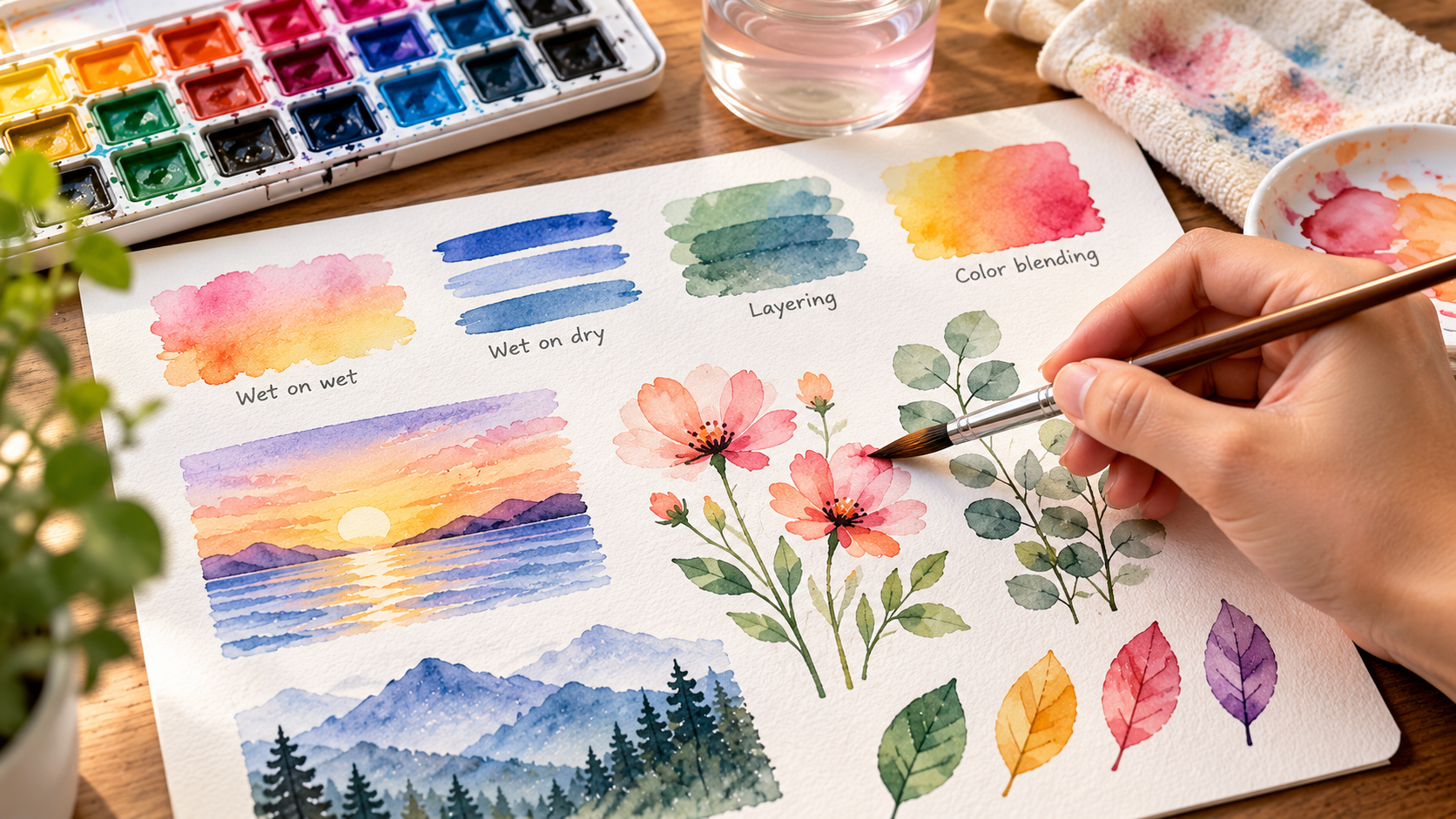
Five Tips to Make Beginner Watercolor Paintings Look Better
You don't need advanced techniques to improve your results. A few small habits can make a noticeable difference.
1. Use fewer colors
Choose two to four main colors for each painting. A limited palette helps everything feel connected and reduces accidental muddy mixtures.
2. Leave some white space
You don't need to fill every inch of the page.
Unpainted areas can suggest sunlight, reflections, or simply give your composition room to breathe.
3. Let layers dry
Adding a new layer too early can cause colors to bleed together.
That can be beautiful when intentional, but frustrating when you want clean shapes or details.
4. Stop before you overwork the painting
Watercolor often looks best when some brush marks remain loose and spontaneous.
If you keep adjusting an area, the paper can become damaged or the colors may turn muddy.
5. Paint small versions first
A small practice painting takes less time and feels less precious.
You can experiment freely without worrying about wasting a large sheet of paper.
A finished little painting is often more satisfying than an ambitious one you never begin.
A Simple 7-Day Watercolor Challenge
If you'd like to turn watercolor into a regular hobby, try one tiny project each day for a week.
Day | Project | Main skill |
|---|---|---|
1 | Abstract circles | Water control |
2 | Soft rainbow | Brush movement |
3 | Sunset sky | Blending |
4 | Loose flowers | Simple brush shapes |
5 | Mountain landscape | Layering |
6 | Tiny potted plant | Details |
7 | Greeting card | Combining skills |
You don't have to complete the challenge in seven consecutive days. Spread it across two weeks or work through it whenever you have a spare moment.
If finding time is difficult, our guide to making time for hobbies offers practical ways to fit creative activities into a busy routine.
Frequently Asked Questions
What is the easiest thing to paint with watercolor?
Abstract circles, simple rainbows, and sunset skies are among the easiest beginner projects. They require very little drawing and help you practice using water and pigment.
Can I start watercolor painting if I can't draw?
Absolutely. Many beginner watercolor projects rely on simple shapes, washes, and brush marks rather than detailed drawing. Abstract paintings, loose flowers, and layered landscapes are good starting points.
How long should a beginner watercolor painting take?
A small beginner project can take around 10–30 minutes of active painting, although drying between layers may add extra time. Starting with short projects helps you practice without feeling overwhelmed.
What colors should a beginner use?
A basic set with yellow, red, blue, and a few earth tones is enough to get started. You can mix many additional colors from a small palette. For individual projects, try limiting yourself to two to four main colors.
Why do my watercolor paintings look muddy?
Muddy colors often result from mixing too many pigments, repeatedly brushing over wet areas, or adding new colors before previous layers have dried. Try using fewer colors, cleaner water, and fewer brushstrokes.
Should beginners copy watercolor paintings?
Using reference images and following tutorials can be helpful when learning. For public sharing or commercial use, make sure you have the right to reproduce any reference artwork. As your confidence grows, experiment with your own compositions and subjects.
Final Thoughts: Start Small and Keep Painting
Watercolor painting doesn't have to be complicated to be rewarding.
A tiny sunset, a row of colorful houses, or a simple flower can give you the satisfaction of creating something with your own hands.
Choose one of these 15 easy watercolor painting ideas, set aside a little time, and see what happens.
Your first painting might not look exactly as you imagined. That's fine. The important part is discovering what you enjoy about the process.
If watercolor feels like something you'd love to keep exploring, visit our Watercolour Painting hobby hub for more inspiration and ways to make painting part of your offline life.
Start with one small painting. You can always make another tomorrow.