How to Find Time for Hobbies When You're Always Busy
You don't need a perfectly organized schedule, a free weekend, or two uninterrupted hours to enjoy a hobby. Sometimes, all you need is ten minutes and permission to spend them on something you like.
You finish work, take care of whatever needs doing at home, answer a few messages, and finally sit down.
Then you look at the clock.
It's late. You're tired. And that book you wanted to read, the sketchbook you bought, or the little embroidery project you started is still waiting.
If this sounds familiar, you're not alone in feeling that hobbies are difficult to fit into everyday life.
The problem isn't always that you have absolutely no free time. Sometimes your available time comes in small, unpredictable pieces. Sometimes you have a little time but not enough energy. And sometimes, after a long day of responsibilities, doing something just for enjoyment feels strangely hard to justify.
The solution isn't to turn your hobby into another obligation.
It's to find a way for it to belong in the life you already have.
Here's how to make time for hobbies—even when your schedule is full.
Why Is It So Hard to Find Time for Hobbies?
When people imagine having a hobby, they often picture the ideal version of it.
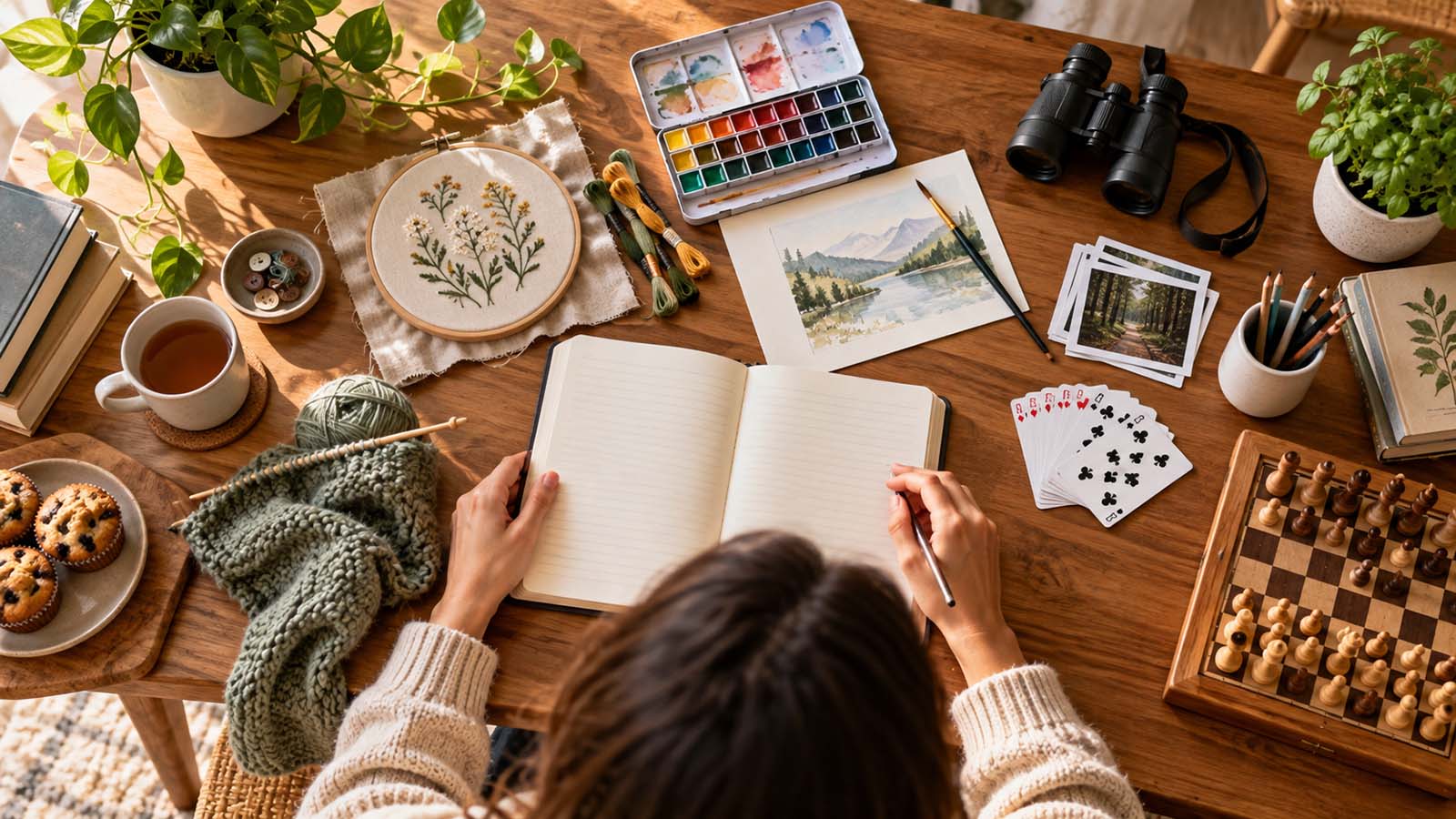
A quiet afternoon painting by a window. A long walk through the countryside. An hour spent reading without interruptions.
Those moments sound wonderful. But they're not always realistic.
Real life includes jobs, commuting, children, family commitments, household chores, and days when you're simply exhausted.
And hobbies often become the first things we remove from our schedules because they don't feel urgent.
Nobody is waiting for you to finish a watercolor painting. There's no deadline for learning to crochet. Your sketchbook won't send you a reminder.
But that doesn't make these activities unimportant.
Hobbies offer opportunities for enjoyment, curiosity, creativity, movement, connection, and rest. Their value doesn't have to be measured by what you produce.
1. Stop Waiting for a Completely Free Afternoon
One of the biggest obstacles to having a hobby is believing that you need a large block of uninterrupted time.
You might tell yourself:
I'll start drawing when work slows down.
I'll read more when the house is quieter.
I'll learn embroidery when I have a whole weekend free.
I'll spend time outdoors when life becomes less busy.
But schedules rarely become permanently empty.
Instead of waiting for the perfect opportunity, look for the smallest version of the activity you want to enjoy.
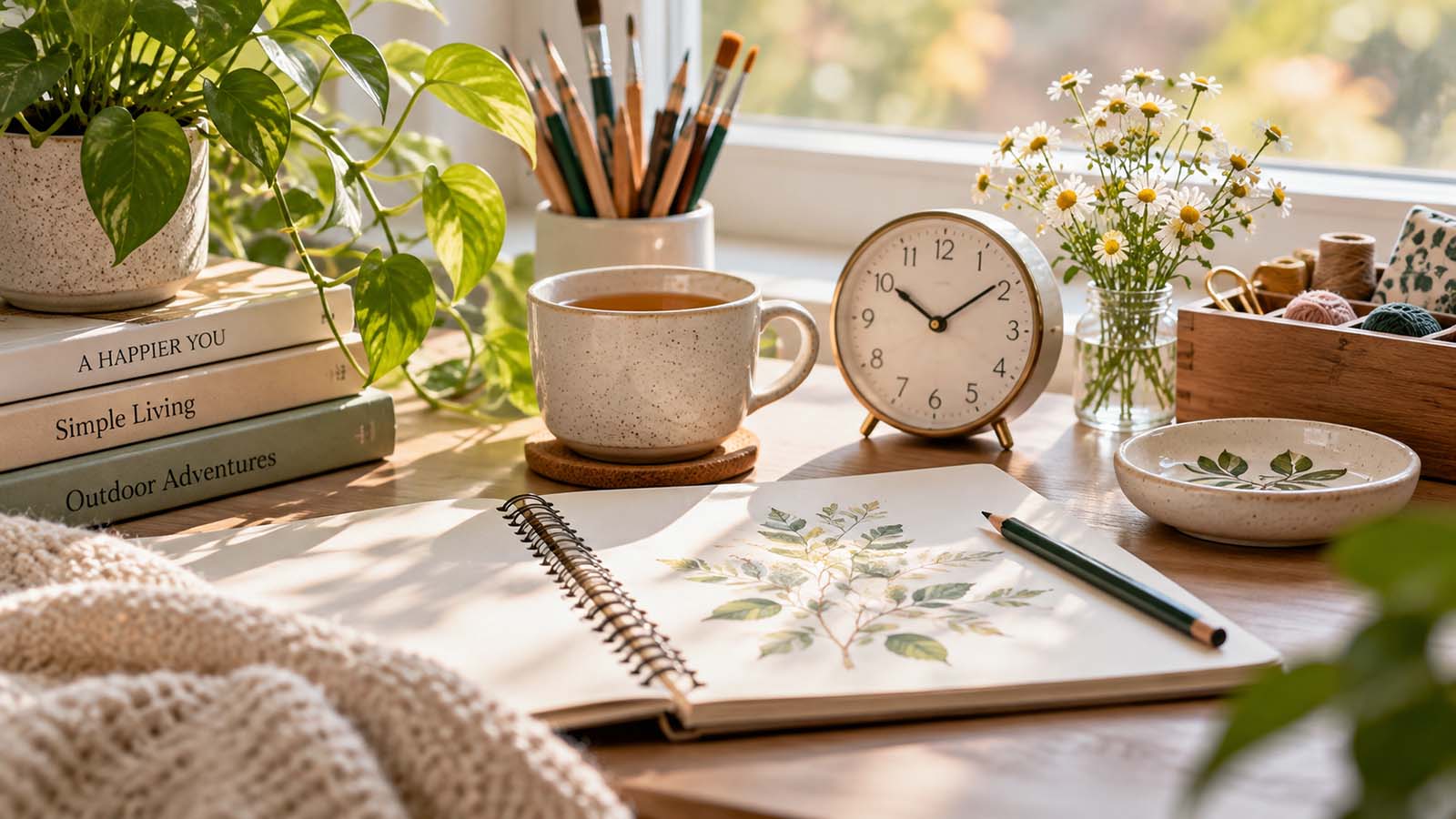
You don't need to finish a drawing. You can sketch one object.
You don't need to read an entire chapter. You can read three pages.
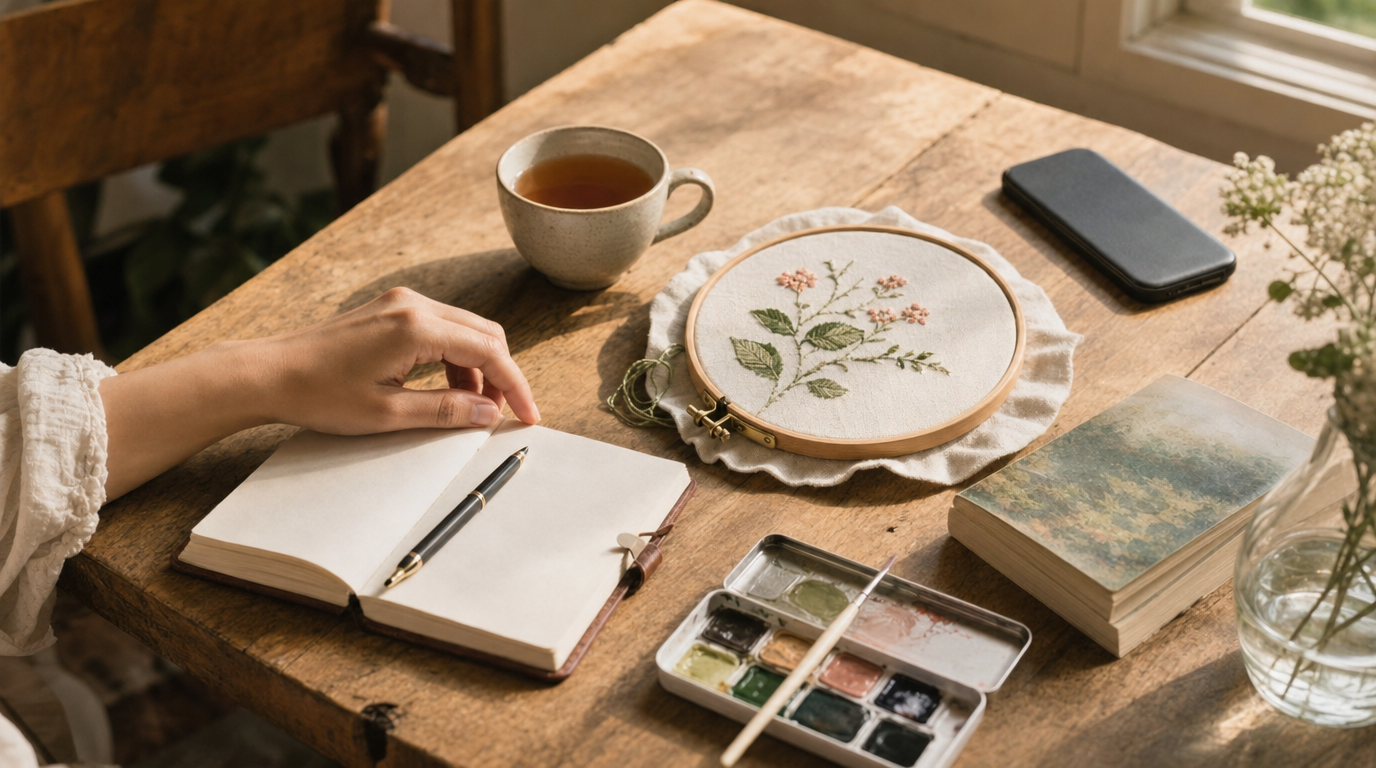
You don't need to complete an embroidery pattern. You can stitch a few leaves.
A hobby doesn't have to produce a finished result every time you sit down.
Sometimes the experience itself is enough.
Try the Ten-Minute Version
Ask yourself:
What would this hobby look like if I only had ten minutes?
For example:
Hobby | Ten-minute version |
|---|---|
Reading | Read a few pages |
Sketching | Draw your coffee cup |
Journaling | Write five sentences |
Embroidery | Practice one stitch |
Gardening | Water plants and inspect new growth |
Birdwatching | Watch birds from a window or garden |
Photography | Take five thoughtful photographs |
Yoga | Follow a short, gentle routine |
These aren't inferior versions of the hobbies.
They're simply ways to enjoy them within the time available.
If you're looking for activities that fit into short breaks, explore our 50 things to do instead of scrolling.

2. Find Your Realistic Hobby Windows
Before rearranging your entire schedule, pay attention to how your days actually work.
You might discover that your free time doesn't arrive in one predictable block.
Instead, it appears in small windows:
Ten minutes before the household wakes up
A short break between tasks
Fifteen minutes after lunch
The time you usually spend scrolling before bed
A quiet period while waiting for an appointment
Part of a weekend morning
Not every gap should become hobby time. Some moments are better used for genuine rest.
The goal is simply to notice when a little enjoyable activity might fit naturally.
Try a Three-Day Time Check
For three ordinary days, make a quick note of moments when you had both a little time and some energy.
You don't need a detailed productivity tracker.
Just write something like:
Monday: Fifteen minutes after dinner. Felt tired but wanted something quiet.
Tuesday: Ten minutes during lunch. Could have read a few pages.
Wednesday: Twenty minutes on the weekend morning. Felt energetic enough to go outside.
After three days, look for patterns.
You may find that evenings are better for reading, while weekend mornings are better for more active hobbies.
You may also discover that some days genuinely leave no room. That's useful information too.
A realistic hobby routine should work with your circumstances, not pretend they don't exist.
3. Choose Hobbies That Match Your Energy, Not Just Your Time
Having twenty free minutes doesn't necessarily mean you have twenty minutes of creative energy.
After a demanding day, learning a complicated new skill may feel like too much.
On another day, you might be excited to try something challenging.
That's why it's helpful to think about energy as well as time.
Low-Energy Hobby Ideas
When you're mentally tired, consider activities that require little setup or decision-making:
Reading something enjoyable
Coloring
Listening to music with your phone put away
Simple journaling
Working on familiar embroidery stitches
Watching birds from a comfortable spot
Medium-Energy Hobby Ideas
When you have a little more focus:
Sketching
Cooking a new recipe
Practicing calligraphy
Making a small paper craft
Learning a new embroidery stitch
Taking a short photography walk
Higher-Energy Hobby Ideas
When you're feeling active:
Hiking
Cycling
Dancing
Gardening
Playing a recreational sport
Exploring a new walking route
These are examples, not fixed categories. An activity that feels restful to one person may be demanding to someone else.
The important question is:
What would feel enjoyable with the energy I have today?
If you're unsure which activities suit your preferences, try OFFLIVA's Find My Hobby tool.
4. Make Your Hobby Easy to Start
Sometimes the biggest obstacle isn't finding time.
It's getting started.
Imagine wanting to draw for fifteen minutes, but first needing to find your sketchbook, sharpen a pencil, clear the table, and decide what to draw.
By the time you're ready, the moment may have passed.
Small practical changes can make a surprising difference to how approachable a hobby feels.
Create a Small Hobby Station
You don't need a dedicated craft room.
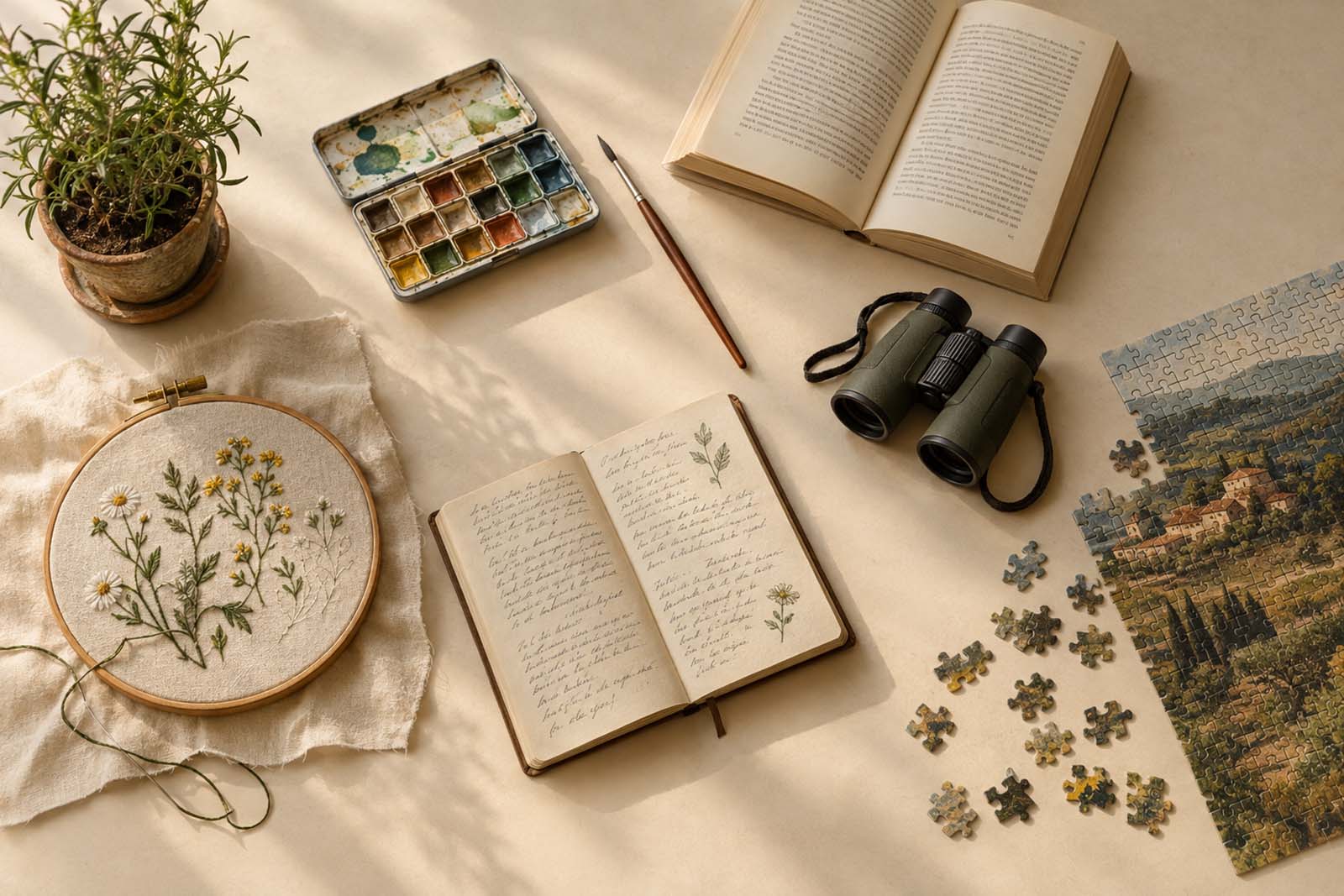
A basket, drawer, shelf, or small box can hold everything required for a simple activity.
For example:
Reading: Keep a book beside your favorite chair.
Sketching: Store a sketchbook and pencil together.
Embroidery: Keep your hoop, thread, needle case, and scissors in one pouch.
Journaling: Leave a notebook and pen somewhere convenient.
Birdwatching: Keep binoculars near a suitable window or by the door.
The idea is to remove unnecessary preparation.
When you have a short window of free time, you can begin without searching for supplies.
Decide What You'll Do Beforehand
A vague plan such as “I'll do something creative later” requires another decision when you're already tired.
A specific plan is easier to act on.
Try:
I'll sketch one plant after lunch.
I'll read for ten minutes before bed.
I'll work on my embroidery flower after dinner.
I'll take a short nature walk on Saturday morning.
Keep the plan small enough that it feels inviting.
5. Replace a Little Scrolling With Something You Enjoy
Phones can fill almost any spare moment.
You pick one up to check a message, open another app, and suddenly the ten-minute break you expected has disappeared.
This doesn't mean every minute of screen time is wasted.
Sometimes scrolling is genuinely entertaining or relaxing.
But if you regularly finish a scrolling session wishing you'd done something else, that moment may be worth experimenting with.
The Ten-Minute Swap
Choose one time of day when you often scroll automatically.
For one week, try spending the first ten minutes of that period on an offline activity instead.
You could:
Read a book
Make a small sketch
Write in a journal
Do a simple puzzle
Practice embroidery
Sit outside and notice your surroundings
After ten minutes, you're free to stop.
There's no need to ban your phone or make an all-or-nothing rule.
You're simply creating an opportunity to choose something different.
For more inspiration, explore 50 things to do instead of scrolling.
6. Stop Turning Your Hobby Into Another Achievement
A hobby can start as something enjoyable and slowly become another source of pressure.
You begin sketching because it's relaxing.
Then you decide you should improve quickly.
Soon you're comparing your drawings with professional artists, tracking your progress, and feeling disappointed when you miss a day.
The same thing can happen with reading goals, exercise routines, crafts, and other interests.
Learning and improving can be rewarding. But improvement doesn't have to be the purpose of every hobby.
You are allowed to:
Draw badly and enjoy it.
Read slowly.
Repeat the same easy embroidery pattern.
Garden without growing perfect vegetables.
Take photographs you never share.
Try a hobby without becoming especially good at it.
REMEMBER
Your hobby doesn't need to become a side business, a social media account, or a personal improvement project. It's allowed to be something you simply like doing.
If you enjoy having goals, use them.
If goals make your hobby feel like work, let them go.

7. Build a Flexible Hobby Routine
Consistency can help make a hobby feel like a normal part of life.
But consistency doesn't have to mean doing the same activity at exactly the same time every day.
For busy adults, a flexible routine is often more realistic.
Option A: The Daily Micro-Hobby
Spend five to fifteen minutes on a hobby when your day allows.
This works well for activities such as reading, journaling, sketching, and simple crafts.
Option B: The Twice-a-Week Hobby
Choose two possible hobby sessions each week.
For example, Tuesday evening and Saturday morning.
If one session doesn't happen, you haven't failed. You still have another opportunity.
Option C: The Weekend Hobby
Reserve a small portion of a weekend for an activity that needs more time.
This could be a longer walk, a baking project, gardening, or a social hobby.
Option D: The Flexible Hobby Menu
Instead of scheduling one specific activity, keep a short list based on your available time.
Five minutes: Write a few lines in a journal.
Fifteen minutes: Read or sketch.
Thirty minutes: Work on a craft project.
One hour or more: Go for a walk, try a recipe, or meet a friend for an activity.
This approach lets you choose what fits the day rather than forcing the day to fit the hobby.
8. What If You're Too Busy or Tired for Any Hobby?
Sometimes life really is too full.
You might be caring for a family member, working unusually long hours, dealing with a demanding period at home, or simply struggling to get enough rest.
In those circumstances, finding extra activities isn't always the right priority.
You don't need to squeeze a hobby into every available minute.
Rest matters too.
Consider three alternatives.
Make the Hobby Smaller
Instead of thirty minutes of reading, try five.
Instead of a full craft project, practice one stitch.
Make It Less Frequent
You might enjoy a hobby once a week, once a fortnight, or whenever an opportunity appears.
That still counts.
Take a Break Without Guilt
Sometimes the most helpful decision is to put a hobby aside temporarily.
You can return when your circumstances change.
A hobby should add something positive to your life, not become evidence that you're falling behind.
9. Try the Seven-Day Hobby Experiment
If you'd like to make room for a hobby but don't know where to begin, try this gentle experiment.
It isn't a challenge to complete perfectly.
It's a way to discover what fits your life.
Day | Small experiment |
|---|---|
Day 1 | Notice one moment when you have ten free minutes |
Day 2 | Choose a hobby you'd genuinely like to try |
Day 3 | Gather the few supplies you need |
Day 4 | Spend five to ten minutes doing the activity |
Day 5 | Try the same hobby at a different time |
Day 6 | Enjoy a slightly longer session if possible |
Day 7 | Reflect on what felt enjoyable and realistic |
At the end of the week, ask yourself:
Did I enjoy the activity?
Was it easy to begin?
Did the timing work?
Did I have enough energy?
Would I like to do it again?
You don't need to turn your answers into a strict schedule.
Use them to make your next hobby session easier.
Frequently Asked Questions
How Much Time Should I Spend on a Hobby Each Day?
There's no universal requirement. Five or ten minutes can be enough for some activities, while others are better suited to longer sessions. Choose a duration that feels enjoyable and sustainable rather than aiming for a fixed daily target.
Can I Have a Hobby If I Only Have Ten Minutes?
Absolutely. Reading, journaling, sketching, simple embroidery, and observing nature can all be enjoyed in short sessions. You don't need to finish a project every time.
What Are Good Hobbies for People With Busy Schedules?
Activities with minimal setup and flexible session lengths are often easier to fit into a busy schedule. Consider reading, drawing, journaling, coloring, photography, or simple hand crafts. For more ideas, explore our 25 offline hobbies for adults.
Should I Schedule My Hobby Like an Appointment?
That can help if you enjoy structure, but it isn't essential. Some people prefer a recurring time, while others do better with a flexible menu of activities. Choose whichever approach makes the hobby easier to enjoy.
What If I Start a Hobby and Then Lose Interest?
That's normal. Interests can change, and trying something doesn't obligate you to continue forever. You can return later, adjust how you participate, or explore something new.
Is It Better to Have One Hobby or Several?
Either can work. One hobby may be easier to maintain, while several can give you options for different moods and energy levels. There's no need to collect hobbies just for the sake of variety.
You Don't Need More Hours to Begin
Finding time for hobbies isn't about squeezing more productivity into an already crowded day.
It's about recognizing that small moments of enjoyment can have a place in ordinary life.
Some weeks, that might mean an hour of painting.
Other weeks, it might mean five minutes with a book, a few stitches in an embroidery hoop, or a short walk around the neighborhood.
You don't need to make every moment count.
You only need to leave a little room for something you enjoy.
Not sure which hobby would fit your time, energy, and interests? Try Find My Hobby and discover an activity that works for your real life—not an imaginary perfect schedule.