You do not need a beautiful notebook, a carefully planned morning routine, a collection of prompts, or an especially interesting life to start journaling.
You need somewhere to write and something small enough to write about.
That sounds simple, but journaling has become surprisingly easy to overcomplicate. Look for inspiration online and you will find elaborate spreads, carefully organized systems, color-coded trackers, expensive notebooks, and people who appear to write three thoughtful pages every morning.
None of that is required.
At its simplest, journaling is spending a little time putting your thoughts, observations, ideas, experiences, or interests onto a page. Your entries can fill five pages or five lines. You can write every morning, once a week, or whenever you feel like returning to it.
The important part is finding a version of journaling that you actually enjoy enough to continue.
If you're still deciding whether journaling is right for you, our guide to finding a hobby you actually enjoy can help you think about hobbies in terms of your time, energy, budget, setting, and personality.
What Is Journaling, Exactly?
A journal is simply a place where you record something for yourself.
That “something” can vary enormously.
You might write about what happened during your day. You might work through an idea, record something you noticed on a walk, make a list of things you want to remember, describe a conversation, sketch something you saw, or write about a question that has been sitting in your head.
There is no single correct form.
That distinction matters because beginners often imagine journaling as one very specific activity: sitting quietly at a desk and writing pages of profound thoughts about life.
It can be that.
But it can also be:
three sentences before bed
a page about something that annoyed you
notes from a weekend trip
a list of things you learned this week
observations from your garden
a record of books you are reading
something funny somebody said
a combination of words, sketches, lists, and scraps
A journal does not have to be impressive. It only has to be useful or enjoyable to the person keeping it.
What You Actually Need to Start Journaling
Very little.
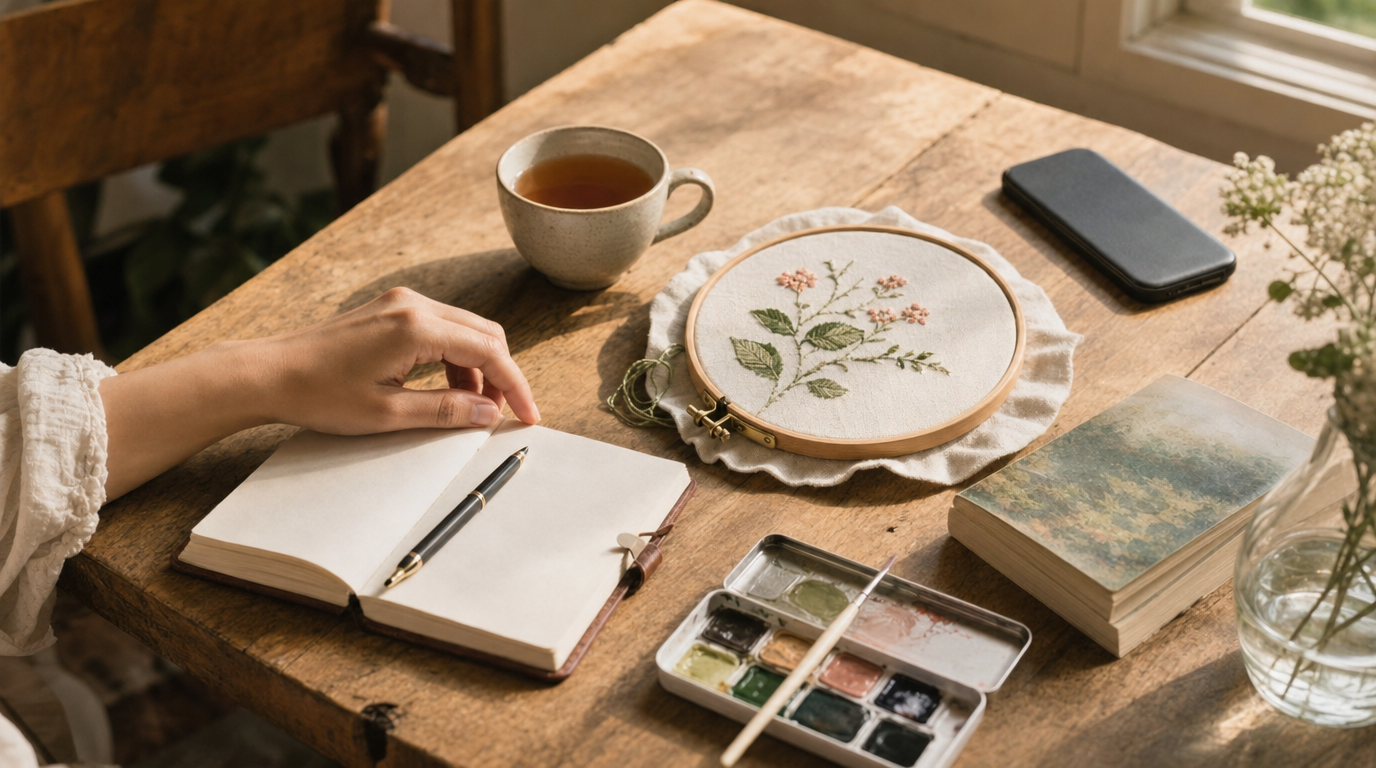
A notebook. Almost any notebook will work. A cheap lined notebook is completely adequate.
A pen or pencil. Use whatever feels comfortable enough that you stop thinking about the tool.
A few uninterrupted minutes. You don't need an hour of silence. Five or ten minutes is plenty for a first attempt.
That's it.
You may eventually discover that you love fountain pens, thick paper, leather covers, stickers, washi tape, or beautifully bound journals. Those can become enjoyable parts of the hobby.
But buying supplies and journaling are two different activities.
Start writing before upgrading your tools.
Start-before-you-shop rule: Use an ordinary notebook for your first few entries. If journaling sticks, you'll have a much better idea of what you actually want from a nicer journal.
Choose a Simple Type of Journaling
You don't have to decide what kind of journal you will keep for the next five years.
You only need somewhere to begin.
Here are six approachable options.
Daily-Life Journaling
Write down what happened during your day and anything you want to remember.
It can be extremely ordinary:
Tuesday
Worked most of the morning. Took a walk after lunch and noticed how quiet the park was. Made pasta for dinner. I need to remember to call Sam tomorrow.
That's a journal entry.
Nothing dramatic happened. Nothing profound was discovered. But a small piece of an ordinary Tuesday now exists somewhere other than your memory.
Reflective Journaling
Instead of recording events, write about something you have been thinking about.
Begin with:
I've been thinking about...
Then continue without worrying about where the entry is going.
This can work particularly well when an idea keeps returning to your mind and you simply want somewhere to explore it.
Observation Journaling
Record things you notice.
This pairs naturally with other offline hobbies for adults, particularly activities that encourage you to pay attention to your surroundings.
You might record:
birds you saw
plants beginning to flower
weather changes
interesting conversations
details from places you visited
something unusual you noticed
small changes in your neighborhood
The journal becomes a reason to notice ordinary life a little more carefully.
Project or Interest Journaling
Your journal can revolve around something you already enjoy.
A reading journal might contain reactions to books.
A gardening journal might record planting dates and observations.
A cooking journal might contain experiments, substitutions, and recipes worth making again.
A creative journal might collect sketches, ideas, phrases, colors, or scraps.
If writing directly about yourself feels uncomfortable, this can be one of the easiest ways to begin.
List Journaling
Not every journal entry needs paragraphs.
Try lists such as:
things I enjoyed this week
places I want to visit
things I learned recently
questions I want to investigate
meals worth making again
books I want to read
things I noticed today
Lists remove much of the pressure created by an empty page.
Visual Journaling
Words aren't compulsory either.
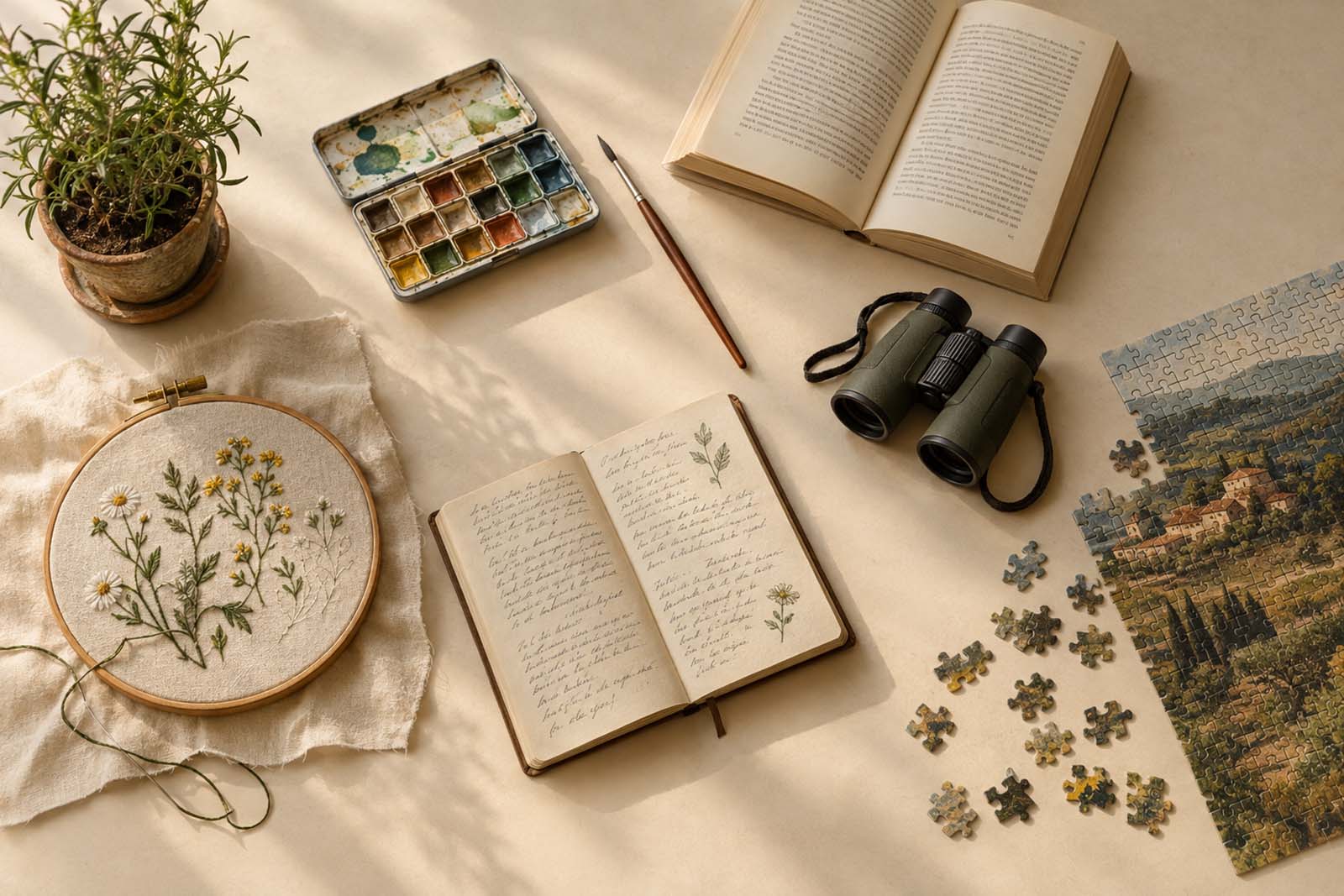
You can combine handwriting with sketches, diagrams, tickets, pressed leaves, photographs, maps, or other small pieces of everyday life.
The result can sit somewhere between a traditional journal and a scrapbook.
You don't have to choose one of these approaches permanently. Try whichever one sounds easiest today.

Your First Journal Entry
The hardest journal entry is often the first one because a completely empty notebook can feel strangely important.
Make the first page deliberately unimportant.
Write the date.
Then write:
I'm starting this journal because...
Finish the sentence.
If you don't know why you're starting, write that.
For example:
I'm starting this journal because I want something to do at night that doesn't involve my phone. I don't really know what I'm supposed to write here yet, so I'm going to try it for a while and see what happens.
That's enough.
You have started.
The second entry will no longer be the first entry in a perfect notebook. It will simply be the next page.
What Do You Write When You Have Nothing to Write?
This is probably the most common practical obstacle.
You open the notebook.
Nothing arrives.
Instead of searching through hundreds of journaling prompts, keep a handful of questions that you can return to.
What happened today?
Describe one part of your day.
It doesn't have to be the most important part.
What am I thinking about?
Write down whatever has been occupying your attention lately.
What did I notice?
Think about something you saw, heard, tasted, read, or experienced.
What am I looking forward to?
It could be something happening tomorrow or months from now.
What do I want to remember?
This is especially useful after an ordinary but enjoyable day.
What am I curious about?
Write down a question rather than trying to produce an answer.
That question may become tomorrow's entry.
Try the Five-Minute Journal Entry
If journaling feels like a commitment, make the session smaller.
Give yourself five minutes.
Write the date and start with one of these:
Today I noticed...
Right now I'm thinking about...
One thing I don't want to forget is...
Something I'm curious about is...
Then write until you have said what you wanted to say.
You don't have to keep writing until the five minutes are finished, and you don't have to stop if you want to continue.
The point isn't to produce a certain amount of writing.
It is to make starting easy.
You Don't Have to Journal Every Day
A daily streak can be motivating for some people.
For others, it turns a hobby into an obligation.
If you miss Tuesday and Wednesday, nothing has gone wrong. Your notebook will still be there on Thursday.
You can journal:
every evening
on Sunday mornings
after interesting days
while drinking your weekend coffee
when traveling
when you have something you want to think through
whenever you remember
Regularity can help an activity become familiar, but regular does not have to mean daily.
A journal with gaps is still a journal.
Make Journaling Easy to Return To
Instead of relying entirely on motivation, give your journal a convenient place in your life.
Keep it beside the chair where you drink coffee.
Put it on your bedside table.
Leave it beside the book you're reading.
Carry a small notebook when you go walking.
The goal isn't to create a rigid routine. It is simply to reduce the number of steps between thinking I should write that down and actually doing it.
You can also create a tiny minimum:
One sentence counts.
On days when you want to write three pages, write three pages.
On days when all you want to write is:
Long day. Had dinner with Anna. The rain finally stopped.
that counts too.
Don't Turn Your Journal Into Homework
One of the easiest ways to abandon journaling is to create too many rules.
You decide that every entry must include the date, weather, gratitude list, daily reflection, tomorrow's priorities, a quote, and a beautifully drawn header.
Suddenly opening your notebook means completing an assignment.
If elaborate journaling is genuinely enjoyable for you, wonderful.
But don't assume complexity makes the hobby better.
Remove anything that makes you reluctant to open the notebook.
Your Handwriting Doesn't Matter
Your journal isn't a typography portfolio.
Messy handwriting is allowed.
Crossed-out words are allowed.
Spelling mistakes are allowed.
Half-finished sentences are allowed.
You don't have to rewrite a page because it looks untidy.
In fact, treating the notebook as something that can be imperfect often makes it much easier to use.
A pristine notebook can become an object you're afraid to spoil.
A used notebook becomes yours.
You Don't Need Interesting Things to Happen
Another common assumption is that journaling requires an interesting life.
It doesn't.
Ordinary life contains plenty to record:
the first tomato appearing on a plant
a strange interaction at the grocery store
a book you couldn't stop reading
a recipe that failed spectacularly
a bird you keep seeing outside your window
a conversation you want to remember
a small decision you're trying to make
a quiet afternoon that felt particularly good
These details may seem insignificant when they happen.
That doesn't make them unworthy of a page.
Keep Your Journal Private If You Want To
Knowing someone might read your journal can change the way you write.
If privacy matters to you, decide where the notebook will live.
That could simply mean keeping it in a drawer rather than leaving it on a shared table.
You can also choose how personal you want the journal to be. There is no requirement to record your deepest thoughts.
Your journal could contain observations, books, recipes, sketches, travel notes, project ideas, or daily events without becoming intensely personal.
You control what goes onto the page.
What If You Miss a Week—or Six Months?
Open the notebook to the next empty page.
Write today's date.
Continue.
You do not need to explain your absence.
You do not need to reconstruct everything that happened.
And you definitely don't need to buy a new notebook because you “failed” the old one.
A hobby should be something you can return to.
The ability to restart is more useful than maintaining a perfect streak.
Common Beginner Journaling Mistakes
Buying the Perfect Journal Before Writing Anything
A beautiful notebook can be motivating, but it can also make the first page feel intimidating.
Start ordinary. Upgrade later.
Collecting Prompts Instead of Writing
Prompts are useful when you're stuck, but finding the perfect prompt can become another form of preparation.
Pick one question and start.
Trying Too Many Journaling Systems
Morning pages, bullet journals, gratitude journals, commonplace books, reading journals, travel journals—there are countless approaches.
You don't need to choose all of them.
Try one simple style first.
Expecting Every Entry to Be Meaningful
Some entries will be thoughtful.
Others will essentially say that you had lunch and it rained.
Both belong in a journal.
Forcing Yourself to Write Every Day
If daily writing makes you look forward to journaling, continue.
If it makes you avoid the notebook, change the schedule.
Comparing Your Pages With Journals Online
The pages people photograph and share are often the pages worth photographing and sharing.
Your journal does not need to look like content.
It can simply look used.
A Simple Seven-Day Journaling Experiment
If you want a little structure without making a long-term commitment, try journaling for seven days.
Day 1 — Why are you starting?
Write about what made you interested in journaling.
Day 2 — Notice something.
Record three things you noticed today.
Day 3 — Remember something.
Write about a small moment from the last week that you would like to remember.
Day 4 — Follow your curiosity.
Write about something you've been wondering about.
Day 5 — Make a list.
Choose any subject and fill a page—or half a page—with a list.
Day 6 — Write about an interest.
Record something related to a book, hobby, place, project, or subject you enjoy.
Day 7 — Review.
Look back through the previous six entries.
Then ask yourself:
Which entry was easiest to write?
Which one did I enjoy most?
Those answers can tell you more about the kind of journaling you might enjoy than another fifty prompts can.
Let Your Journal Become Something
You don't have to decide exactly what your journal is before you start it.
Let the notebook develop naturally.
Perhaps you begin by recording your days and gradually start writing more about books.
Perhaps sketches begin appearing beside your entries.
Perhaps your journal becomes mostly lists.
Perhaps you discover that you love documenting walks, recipes, gardening, films, or conversations.
That's not inconsistency.
That's discovery.
The notebook can change as your interests change.
Journaling Can Be a Hobby, Not a Self-Improvement Project
There is a tendency to make every hobby productive.
You start journaling, and soon you're supposed to use it to optimize your mornings, organize your goals, measure your habits, become more productive, and transform yourself.
You don't have to.
Journaling can simply be time spent away from a screen, paying attention to your thoughts, interests, or the world around you.
You are allowed to write something that has no measurable outcome.
You are allowed to keep a notebook because you enjoy keeping a notebook.
Start Tonight
Don't wait until you find the right notebook.
Take whatever paper you already have.
Write today's date.
Then answer one question:
What is one thing from today that I would like to remember?
Write three sentences.
Close the notebook.
You have started journaling.
Tomorrow, you can decide whether you want to open it again.
If you'd like to explore journaling as an ongoing offline hobby, visit the Journaling Hobby Hub for a simple overview of the hobby and ways to get started.