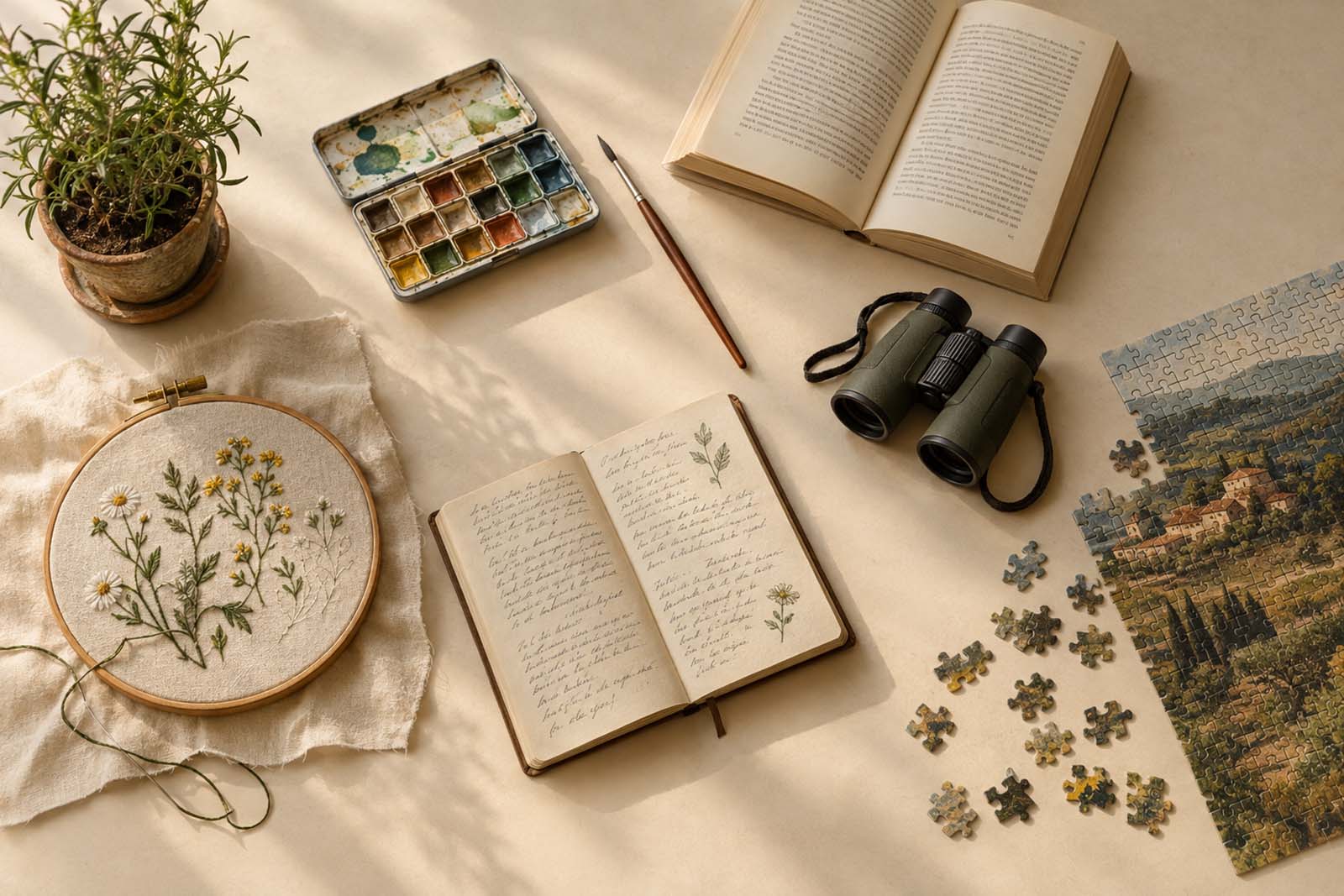
You open your notebook, pick up your pen, and stare at the empty page.
You want to write something. You just don't know what.
Maybe nothing particularly interesting happened today. Maybe you have plenty on your mind but can't figure out where to begin. Or maybe you're new to journaling and aren't entirely sure what belongs in a journal.
The good news is that you don't need a fascinating story, a big realization, or even a complete sentence to get started.
Sometimes, all you need is a question.
These 25 journaling prompts for beginners are designed to make the first few lines easier. They're simple enough to try in five minutes, varied enough to keep things interesting, and open-ended enough to make each response your own.
If you're completely new to the hobby, start with our How to Start Journaling: A Beginner's Guide. It covers the basics, from choosing a notebook to writing your first entry.
Otherwise, pick a question below and see where it takes you.
How to Use These Journaling Prompts
You don't need to work through this list in order.
The prompts are divided into five groups:
Everyday life: Notice small things happening around you.
Memories: Capture moments you might otherwise forget.
Curiosity: Explore questions and interests.
Creativity: Use imagination and playful writing.
Gentle reflection: Think about your preferences, experiences, and what matters to you.
Choose whichever category appeals to you today.
Write the prompt at the top of a page, then answer it in your own words. If the question doesn't interest you after a minute or two, choose another.
There is no minimum word count and no requirement to write every day.
A short, ordinary entry is still a real journal entry.
Everyday Life: 5 Prompts to Notice More
You don't have to wait for something extraordinary to happen before writing about your day.
These prompts help you pay attention to small details that are easy to overlook.
1. What is one small thing you noticed today?
Think about something you saw, heard, smelled, tasted, or felt.
It might be the sound of rain against a window, a dog waiting outside a shop, or the way sunlight moved across your kitchen table.
Try starting with: "Today I noticed..."
You don't need to explain why it mattered. Just describe it.
2. What was the most enjoyable part of your day?
It doesn't have to be the most exciting part.
Maybe you enjoyed your first cup of coffee, a conversation with a friend, or the moment you finally sat down after a busy afternoon.
Describe what happened and what made that particular moment enjoyable.
3. What is something ordinary that you appreciate?
Choose an everyday object, place, routine, or convenience.
It could be your favorite chair, a nearby park, the smell of fresh bread, or a quiet hour before everyone else wakes up.
Write about why you like it.
This is an observation exercise, not a requirement to feel grateful about everything.
4. What did you do differently today?
Think about a small change.
Did you take a different route? Cook something unfamiliar? Speak to someone new? Spend your evening away from your phone?
Describe what you did and whether you'd like to do it again.
If today was completely routine, write about something you'd like to change tomorrow.
5. What would you like to remember about this week?
Imagine reading your journal a year from now.
What small detail would help you remember what this particular week felt like?
It might be a conversation, a meal, a funny incident, or an ordinary afternoon.
Example response:
The neighbor's cat has started sitting on our front steps every morning. It looks through the window as if it's waiting for someone. I wonder how long it has been doing that.
A few sentences can preserve a moment that might otherwise disappear.
Memories: 5 Prompts to Revisit Your Past
Your memories don't have to be dramatic or deeply personal to be worth recording.
Sometimes the most enjoyable things to write about are places, objects, and little moments you haven't thought about in years.
6. What is a place you remember especially clearly?
It could be a childhood bedroom, a school library, a grandparent's kitchen, or a shop you used to visit.
Describe the details.
What did the room look like? What sounds do you remember? Was there a particular smell?
Don't worry about reconstructing everything perfectly. Write what you remember.
7. What is a meal you still remember?
Perhaps it was something delicious, something terrible, or something that became memorable because of the people you were with.
Where were you?
Who prepared it?
What happened around the table?
Food can be a surprisingly enjoyable starting point for storytelling.
8. What is a small adventure you've had?
An adventure doesn't have to involve traveling across the world.
Maybe you got lost on a walk, took an unexpected train, explored a new neighborhood, or visited somewhere on a whim.
Describe how it began and what happened next.
9. What is an object you've kept for a long time?
Look around your home.
Is there a book, photograph, piece of clothing, souvenir, or ordinary object you've held onto?
Write about where it came from and why you still have it.
If you can't think of anything you own now, choose something you used to have.
10. What is a funny moment you don't want to forget?
Think about something that made you laugh.
Maybe someone misunderstood a conversation, a plan went completely wrong, or a pet did something ridiculous.
Write down the story as though you're telling it to a friend.
Don't worry about making it sound polished. The details are what matter.
Curiosity: 5 Prompts to Explore Your Interests
A journal can be a place to collect questions, not just answers.
You don't need expertise in a subject to write about it. Being curious is enough.
11. What is something you've always wanted to learn?
Maybe you've wondered how to recognize birds, make pottery, grow herbs, play chess, or repair an old piece of furniture.
What interests you about it?
What would you like to know first?
You don't need to turn the idea into a project. For now, simply explore the curiosity.
12. What is a question you've been thinking about lately?
It can be practical, unusual, or completely random.
Why do some plants grow better in certain rooms?
How do people remember so many chess openings?
What makes a particular book difficult to put down?
Write the question and explore what you already know, what you suspect, and what you'd like to find out.
13. What is a hobby you'd like to try just once?
Choose an activity that sounds interesting even if you're not sure you'd stick with it.
What would your first attempt look like?
What supplies would you actually need?
Would you prefer to try it alone or with someone?
If you're looking for possibilities, browse our 25 Offline Hobbies for Adults That Are Actually Fun.
14. What is something you've changed your mind about?
It doesn't need to be a major belief.
Maybe you used to dislike a food that you now enjoy. Perhaps you once thought gardening was boring or that you weren't creative.
What changed?
Was it a particular experience, a person, or simply getting older?
15. What would you like to understand better?
Think of a subject that regularly catches your attention.
It might be architecture, local history, photography, nature, cooking, or a language.
Write down three questions you'd ask someone who knows a lot about it.
Those questions could become future journal entries.
Creativity: 5 Prompts to Play With Ideas
Not every journal entry has to be about your real life.
Your notebook can also be a place for imagination, invention, and playful experiments.
These prompts are particularly useful when you want something lighter than personal reflection.
16. Describe your ideal slow Sunday.
Imagine a day with no urgent obligations.
Where would you wake up?
What would you eat?
Would you stay home, go outside, meet someone, or spend the afternoon making something?
Describe the day from morning to evening.
Don't worry about whether it is realistic.
17. Invent a tiny shop you'd love to visit.
It could sell used books, unusual plants, handmade stationery, vintage maps, or something entirely imaginary.
Where is the shop?
What does it look like inside?
Who runs it?
What would make someone want to stay for an hour?
You can describe it in a paragraph or sketch a little floor plan.
18. Write about an object from its point of view.
Choose something nearby: a coffee mug, a bicycle, a houseplant, or a pair of shoes.
Imagine what that object might say about its day.
Example opening:
I've been sitting on this windowsill for three years, and nobody has noticed that the best thing about this room is the afternoon sunlight.
It doesn't have to be clever. The fun is in trying a different perspective.
19. Make a list of ten things you'd put in a personal museum.
Imagine a tiny museum devoted entirely to your life.
What objects would be on display?
They might include a childhood toy, a favorite book, a concert ticket, an old photograph, or something nobody else would recognize as important.
Give each object a short label explaining why it belongs there.
20. Describe a place you've never visited.
Choose a real destination or invent one.
What would you see when you arrived?
What would the streets sound like?
What kind of buildings, shops, landscapes, or people might be there?
If it's a real place, treat this as an imaginative exercise rather than pretending you've visited it.
You can research the destination later if it still interests you.
Gentle Reflection: 5 Prompts to Understand Your Preferences
Reflective journaling doesn't have to mean asking yourself enormous questions about the meaning of life.
You can start with smaller questions about what you enjoy, what you prefer, and how you spend your time.
21. When do you feel most comfortable being yourself?
Think about a place, activity, or situation where you don't feel pressure to perform or impress anyone.
What makes it comfortable?
Is it the environment, the people, the pace, or something else?
You can keep the answer simple.
22. What is something you enjoy that you've stopped making time for?
Maybe you used to draw, read novels, bake, ride a bicycle, or spend time in the garden.
Do you still miss it?
What made it difficult to continue?
If you wanted to return to it, what would a small first step look like?
23. What does a good ordinary day look like to you?
Forget holidays, major achievements, and special occasions.
Think about a regular weekday that you would genuinely enjoy.
How would you spend your morning?
What kind of work or activities would fill the day?
How would you like the evening to feel?
There is no ideal answer. You're describing your preferences, not creating a productivity plan.
24. What is something you'd like to do more often?
Choose one activity rather than trying to redesign your entire life.
Perhaps you'd like to cook at home, visit the library, take walks, make things with your hands, or see friends more often.
Write about why it appeals to you.
Then think of the smallest possible version you could try.
25. What would you like your future self to remember about today?
Imagine finding this journal entry several years from now.
What would you want to tell yourself about your current life?
You could describe where you live, what you enjoy, the people around you, something you're working on, or a small hope for the future.
Try starting with:
If you're reading this a few years from now, here's what life looks like today...
You don't have to make predictions or offer advice.
Sometimes a simple snapshot is enough.
What to Do When a Journal Prompt Doesn't Work
Some questions will immediately give you something to write about.
Others won't.
That doesn't mean you're bad at journaling.
It might simply mean the question doesn't interest you.
When a prompt isn't working, try one of these approaches:
Make it smaller. Instead of describing your entire week, describe one afternoon.
Make it more specific. Instead of writing about your favorite memories, choose one meal or one place.
Change the format. Answer with a list, a sketch, or three short sentences.
Choose another question. You don't have to finish every prompt you start.
Write about why you're stuck. Sometimes "I don't know what to write about this" is a perfectly reasonable beginning.
And remember that not every entry needs to become a meaningful reflection.
Some days, recording a funny conversation or describing the weather is enough.
Should You Use a Different Prompt Every Day?
Only if you enjoy doing that.
You can repeat the same question whenever you like.
In fact, repeating a simple prompt such as "What did I notice today?" can produce completely different entries depending on the day.
You might also prefer to use prompts only when you're stuck.
On other days, you can write freely about whatever comes to mind.
There is no need to complete a 25-day challenge or maintain a perfect streak.
The prompts are tools you can return to whenever they're useful.
Make Your Own Journaling Prompts
Once you've tried a few of these questions, you may begin noticing which kinds of entries you enjoy most.
Perhaps you love recording memories.
Perhaps you prefer observations from everyday life.
Maybe imaginative prompts make writing feel like play, while reflective questions feel too much like homework.
Pay attention to that preference.
You can create your own prompts by starting with:
What did I notice about...?
What do I remember about...?
What would happen if...?
What am I curious about...?
What do I enjoy about...?
Fill in the blank with something that interests you.
For example, someone who enjoys gardening might ask, "What changed in the garden this week?"
A reader might ask, "Which character from my current book would I like to meet?"
A person who enjoys walking might ask, "What did I see on today's route that I hadn't noticed before?"
Your journal can grow around the interests you already have.
Choose One Prompt and Begin
You don't need to answer all 25 questions.
You don't even need to choose the best one.
Pick whichever question made you stop for a moment and think, I could write about that.
Open a notebook.
Write the date.
Give yourself five minutes.
If you write one sentence, you've started. If you fill a page, that's fine too.
And if you discover that you enjoy keeping a notebook, there are plenty of ways to make journaling your own.
Explore the Journaling Hobby Hub for more ideas on starting and enjoying this screen-free hobby.
Explore the Journaling Hobby Hub →